
Our Core Curriculum
Our core curriculum builds strong foundations in English and Mathematics through clear, evidence-based teaching that supports every student to grow, achieve and succeed.
English

Mathematics

Wellbeing
The Berry Street Model
Resilience, Rights and Respectful Relationships
What This Looks Like Day to Day
English


At Newtown Primary School, building a strong literacy foundation sits at the very heart of every student’s learning journey.
Our literacy program enables our students to grow into confident communicators, imaginative thinkers and informed citizens, equipped to engage not just within our school community but in a global, rapidly changing world. We aim and strive for our students to develop a love of literacy and literature, whether that be reading and understanding quality text, and or creating it through written and published means. As previously shared, we lean heavily on the Department of Education’s English VLPs, which incorporate dedicated and explicit teaching components.
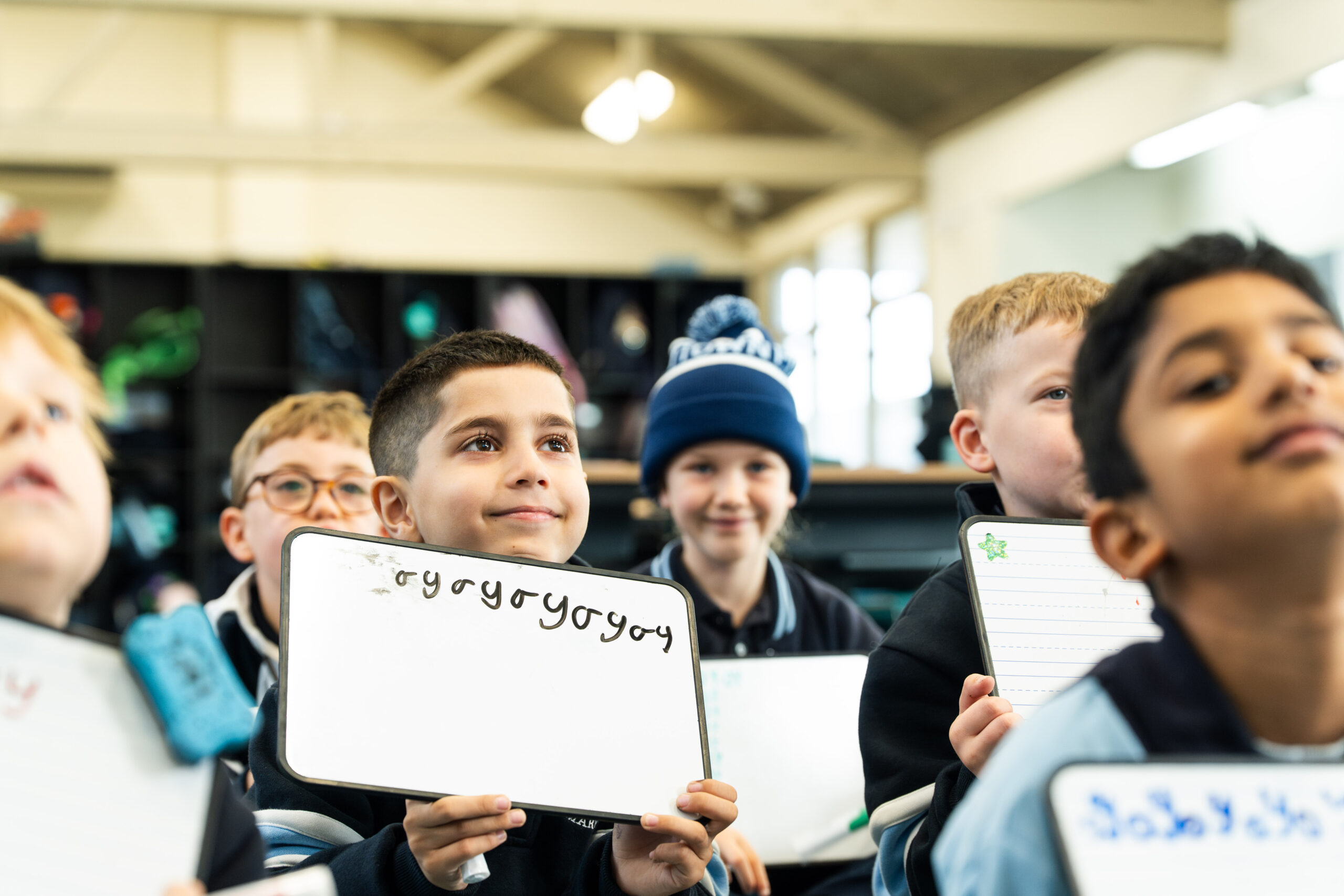
As the starting point, Phonics Plus is the foundational literacy component. This develops core handwriting, high-frequency word knowledge, dictation, and reading fluency, as well as phonic and word knowledge, into daily lessons.
Following this, text-based sequences are taught using a core list of high-quality texts and themes for each level, developing reading, viewing, writing, speaking, and listening together
Literacy skills lessons — explicit, sequential teaching of grammar, punctuation and syntax, with spelling and morphology added from Level 3 onward (e.g. using prefixes, suffixes, roots and base words to build vocabulary)
English at Newtown PS is built upon, and in line with best practice, the “Big 6” of reading instruction (Konza, 2014), which the Department has adopted as the essential elements of a structured literacy approach. This includes;
- Oral language – Using spoken language to express knowledge, ideas and emotions.
- Phonemic awareness – Hearing and manipulating the sounds (phonemes) in words
- Phonics – Connecting sounds to their letter patterns (graphemes)
- Fluency – Reading accurately, at an appropriate rate, and with expression
- Vocabulary – Understanding words in isolation and in context
- Comprehension – Making meaning from text, including through grammatical knowledge
This is why lessons taught don’t treat reading as one generic skill — each element is taught explicitly and built on in sequence, rather than left to develop by exposure alone.
The use of the English VLPs are deliberately sequenced so that each new text or skill draws on knowledge students have already secured — a direct application of the Knowledge and memory and Retention and recall elements of learning. Every sequence embeds explicit vocabulary instruction, and lessons are structured to move students through explicit teaching into supported application, with built-in opportunities to practise, apply and consolidate what’s been taught rather than move on before it has stuck.
Over time, we have built a consistent approach to how we teach English using the high-quality, evidence-based resources we have available at our disposal.
Mathematics

We utilise the Mathematics Victorian Lesson Plans which run from Foundation to Year 6 and are aligned to the Victorian Curriculum: Mathematics 2.0. Like English, they follow an intentional sequence, so a concept isn’t introduced until our students have the prerequisite knowledge to access it — and the Department is explicit – that mastery isn’t a one-off event: teachers are expected to revisit, review and practise skills throughout the year to consolidate learning. This we do via engaging in daily review and fact fluency lessons.
Mathematics at Newtown PS is taught guided by the Department’s Mathematics Position Statement, which frames numeracy as a fundamental life skill and sets evidence-based teaching as the priority for lifting outcomes for every student. What this means in practice is:
- Explicit teaching remains the core approach — new concepts, procedures and mathematical vocabulary are taught directly and clearly, not left for students to discover unassisted.
- Structured inquiry has a defined, later role — once students have secured the relevant knowledge and skills, lesson structures such as Launch–Explore–Summarise (LES) give them the chance to apply and extend their thinking to more complex and individualised tasks.
- Both the VTLM 2.0 and the Mathematics Position Statement are clear in that minimally guided approaches only work once foundational knowledge is in place. This is why we emphasise and explicitly teach core mathematics skills such as “The Big Ideas” – taken from the Assessment for Common Misunderstanding materials (AfCM), which were published by the Department of Education.
In aligning our teaching of mathematics to the VTLM 2.0’s elements of teaching: Explicit Teaching – this seeks to build the foundational knowledge, followed by Supported Application (including LES-style structured inquiry) to consolidate student mastery and application — one of the four elements of learning.
Whether it’s English or Mathematics, the VLPs we use are certainly not a grab-and-go of worksheets and activities — they are built to a common evidence base that are deliberately sequenced, taught explicitly, and give students genuine, structured opportunities to apply what they’ve learned before moving on.
Wellbeing Education
Prep – Year 6
The Berry Street Education Model: Helping Every Child Feel Ready to Learn

Developed by Berry Street — one of Victoria’s most respected child and family welfare organisations — the Berry Street Education Model brings together trauma-informed practice and positive psychology to help students build the skills they need to engage, persist, and thrive not only nm school but in life.
BSEM is built around five domains that reflect what every child needs in order to be genuinely “ready to learn”. These are;
- Body — Helping students recognise and regulate their stress responses, so they can stay calm, focused and present. This might look like a Brain Break between lessons or a consistent Morning Circle routine that starts the day with connection.
- Relationship — Building strong, trusting relationships between staff and students through predictable routines and consistent, warm classroom management.
- Stamina — Growing students’ capacity for persistence, resilience and a growth mindset, so setbacks become opportunities rather than roadblocks.
- Engagement — Sparking curiosity and motivation through teaching that connects to students’ strengths and interests.
- Character — Nurturing self-awareness, empathy and integrity as the foundation for good decision-making, now and into the future.
What underpins all of this great work is a principle called “unconditional positive regard”. This means treating every student with warmth, respect and belief in their potential, regardless of the day they’re having. Rather than viewing challenging behaviour as something to punish, our teachers and educational support staff are all trained to see it as a form of communication — a signal to understand, not a problem to shut down. This whole-school approach means the same calm, restorative language and practices show up everywhere, from the classroom to the yard to the office.
Resilience, Rights and Respectful Relationships

Resilience, Rights and Respectful Relationships: Building Social and Emotional Skills, Year on Year
Alongside the BSEM, we deliver the Victorian Department of Education’s RRRR curriculum, which has been a core part of the Victorian Curriculum from Foundation to Year 12 since 2016. Developed with experts from the University of Melbourne, RRRR gives students explicit, age-appropriate lessons in the social and emotional skills that underpin healthy relationships and good mental health.
Across the years, students progressively build knowledge in eight key topics:
Emotional Literacy — naming and understanding feelings, in themselves and others
Personal and Cultural Strengths — recognising individual and community identity as a source of resilience
- Positive Coping — developing healthy strategies for managing difficult moments
- Problem Solving — thinking through challenges calmly and constructively
- Stress Management — practical tools for staying regulated under pressure
- Help-Seeking — knowing when and how to ask for support, and who to ask
- Gender Norms and Stereotypes — understanding how expectations around gender can shape behaviour and relationships
- Positive Gender Relations — building respectful, equal relationships with others
These lessons are sequenced across year levels, so the concepts a Foundation student explores through play and story are revisited with increasing depth right through to year 5 and 6, wish is always mapped to the Victorian Curriculum’s Health and Physical Education and Personal and Social Capability strands.